Why Dealer Hedging Moves the Market
“The book is the truth. Everything else is opinion.”
The SPX options book is not one book. It is a thousand books, one per strike, one per expiration, one per side, each with its own depth, its own market makers, and its own liquidity regime. On expiration day, only one of those books actually matters: today's. Tomorrow's chain is asleep. Next week's is barely awake. Today's, by 10 AM, has woken up ten million contracts of open interest.
Who the dealers are
A dealer in options is a market maker, the firm on the other side of every retail trade. When a retail trader buys a call, a dealer typically sells it. When a retail trader sells a put, a dealer typically buys it. The names are public: Citadel Securities, Susquehanna, Optiver. Together they intermediate the bulk of SPX 0DTE flow.
None of them are taking directional bets. Their business is bid-ask spread, and to keep that business running they hedge their book to stay delta-neutral. The directional risk of every retail option ends up offset against the directional risk of every other retail option, with a futures or stock position covering whatever residue remains.
What hedging means
A dealer who sells a zero-DTE SPX call has just taken on negative delta. If SPX rises, the call gains value and the dealer loses money on it. To neutralize the exposure, the dealer buys some quantity of SPX (or SPX futures) to balance the short call's delta. The hedge is sized so that the dealer's book has zero net delta after the trade. A call with delta -0.40 from the dealer's short perspective is offset by buying enough underlying to add +0.40 of delta. The whole position is then directionally flat. The dealer keeps the spread, and the underlying's path no longer matters to the dealer's P&L.
Why gamma changes everything
Delta is not constant, as the last chapter established. When SPX moves toward the strike, the call's delta increases. The dealer's hedge, sized at trade time, is now insufficient. To stay flat, the dealer has to buy more SPX. When SPX moves away from the strike, the call's delta decreases and the dealer must sell some of the hedge. This rehedging happens continuously, mechanically, for every contract on the book.
The direction of the rehedging flow depends on the sign of the dealer's net gamma position. When dealers are net short gamma (most of their book is short calls or short puts), every rise in spot increases their short delta, forcing them to buy more underlying to compensate. Every fall in spot increases their long delta, forcing them to sell. Buy high, sell low. The flow amplifies the move. The faster the underlying moves, the more the dealers must chase. The more they chase, the more they move the underlying.
When dealers are net long gamma, the sign flips. A rise in spot now decreases their long delta, forcing them to sell into the rally. A fall in spot increases their long delta, forcing them to buy. Sell high, buy low. The flow dampens the move. Rallies fade into dealer offers. Selloffs are caught by dealer bids. The underlying tends to oscillate around whatever spot level has the heaviest concentration of dealer positioning.
Structure
Dealer hedging is not a strategy. It is the consequence of having to stay flat in a world where deltas refuse to.
How we measure it
Dealer positioning is not published. There is no feed to subscribe to. What is observable is aggregate open interest by strike and side, the volume of contracts that have traded at each level, and the order flow crossing the tape minute by minute. From those inputs the math estimates which side of each line dealers are most likely on, computes the delta and gamma exposure that implies, and sums across strikes to produce a net number per spot level. The signal at any one strike is noisy. The signal at the index level, aggregated across the whole chain, is robust. Decades of academic work have made the framework defensible. The fact that several quantitative shops independently arrive at similar GEX readings is the empirical confirmation.
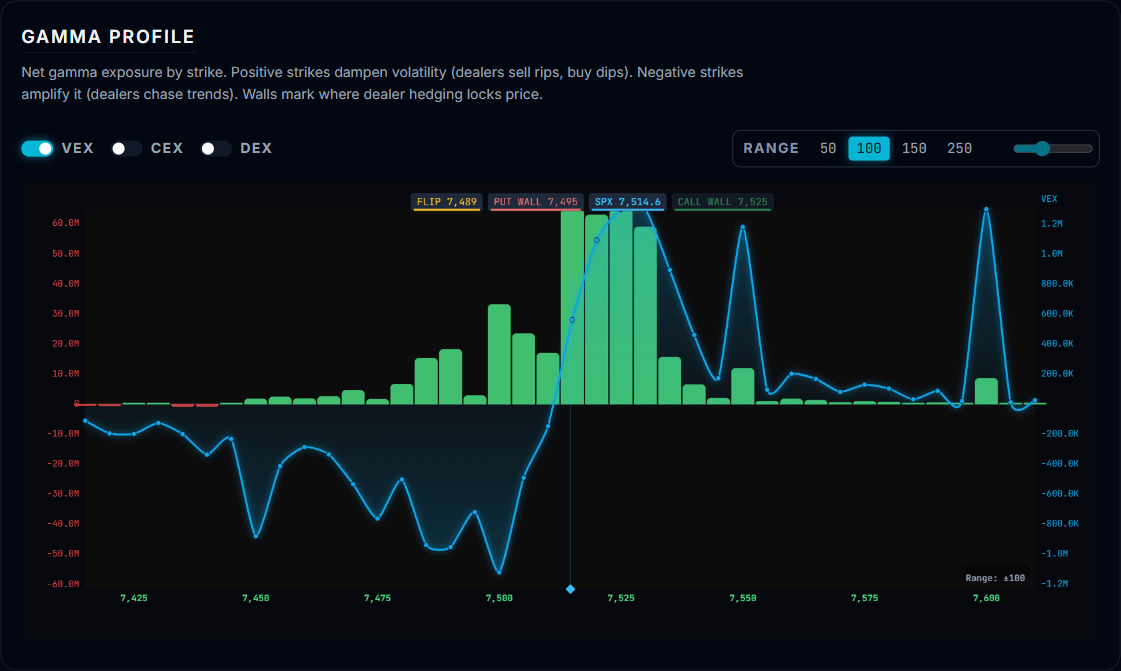
Read the chart slowly. A dealer who is short gamma must hedge into moves, selling low and buying high to stay neutral. That is not a problem when the day is quiet. On a fast-tape day it is gasoline. Every move begets more hedging, every hedge moves the spot, every spot-move begets more hedging. You have seen these days. They are not random.
The structural consequences fall out of this mechanism. A net-long-gamma day tends to be range-bound, because the dealer hedging IS the resistance and the support. A net-short-gamma day tends to extend, because the dealer hedging is the gasoline that keeps the move going. A wall of dealer positioning above the spot tends to act as resistance until the wall breaks, at which point the hedging flow reverses sign and the move accelerates through. These are observed patterns, not predictions. They are the structure inside which the next three chapters operate.
March 16, 2020 was the loudest version of this mechanism the modern SPX chain has produced. SPX closed down twelve percent in a single session, the largest one-day decline since the 1987 crash. The dealer book had been deeply short gamma for weeks as VIX climbed through the forties and fifties on COVID uncertainty. Every leg lower forced dealer-hedging sells; every dealer-hedging sell deepened the next leg. The flow that academic papers describe as 'price-amplifying' was visible to anyone watching the tape. Dealer short-gamma days do not have to be COVID days to produce the same shape on a smaller scale. Any session where GEX prints deeply negative gives the trader the same mechanism on a calmer canvas.
A more recent pair of sessions shows the mechanism running both ways inside a single week. In early April 2025 a surprise round of trade tariffs hit a market sitting near record highs. The dealer book was short gamma into the announcement, and the selling fed on itself: SPX fell almost five percent in one session and six percent the next, a two-day drop of more than ten percent, the steepest since the 2020 crash. VIX traded above sixty intraday. Then the amplification ran the other way. When the harshest tariffs were paused a few days later, the same short-gamma book that had chased the selloff down had to chase the relief rally up, and SPX rose more than nine percent in a single session, one of the largest one-day advances in the post-war era. Nothing about the underlying news was symmetric. The hedging flow was. Short gamma does not pick a direction. It amplifies whichever one the tape hands it.
Related glossary terms
Ready for the mechanics behind all of this? Gamma Exposure, Explained — the complete guide →